Standing resource
The Datasheet Parameter Index
One table, five columns, and no product in it. This is the reference the rest of the publication points back to instead of redefining a term on every page.
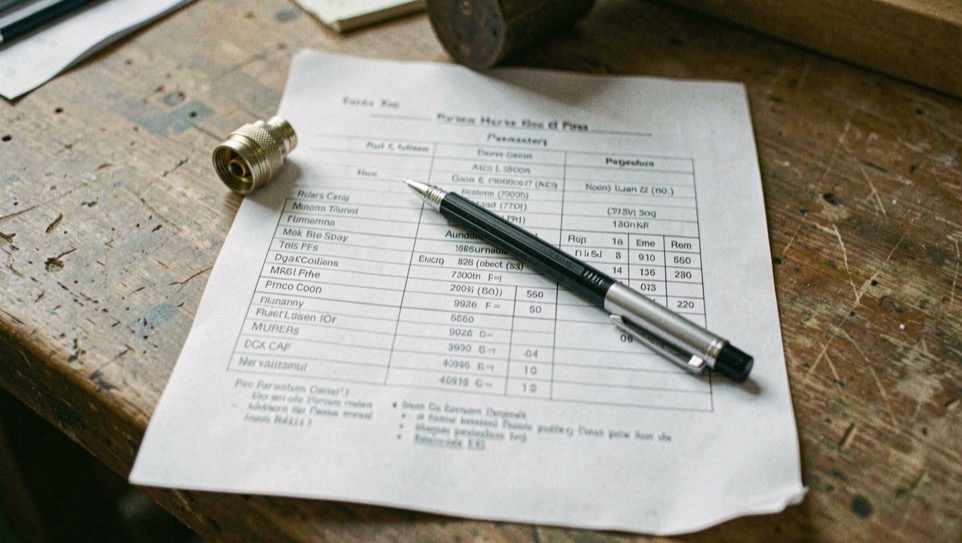
A control component specification is a table of quantities with limits and no definitions. The reader is assumed to know which measurement produced each row and under which condition it was taken. This index closes that assumption in one place. It contains no value, no part number and no maker: a value belongs to a product, and this publication describes no product.
The fifth column is the one worth reading twice. Most disagreements about a specification are not disagreements about the number: they are two people reading the same column as though it answered two different questions.
Transmission and reflection
| Parameter | Unit | What it is | How it is obtained | What it does not say |
|---|---|---|---|---|
| Insertion loss | dB | The loss through the path that conducts. | From the transmission parameter S21, as minus twenty times the base ten logarithm of its magnitude. | Nothing about the blocked path, and nothing about how flat the loss is across the band. |
| Isolation | dB | The attenuation of the path that blocks. | The same measurement as insertion loss, taken with the path switched off. | Whether the blocked port reflects the power or absorbs it. |
| Return loss | dB | How much of an incident wave comes back. | From the reflection parameter S11, as minus twenty times the base ten logarithm of its magnitude. | Where in the part the reflection happens. |
| VSWR | ratio | The same reflection expressed as a standing wave ratio. | Computed from the reflection magnitude as one plus it over one minus it. | Nothing more than return loss says: it is the same measurement on another scale. |
| Amplitude flatness | dB | The variation of loss across the specified band. | The peak to peak spread of the transmission trace over the band. | Where in the band the extremes fall, which matters if a system uses one corner. |
Switching and control
| Parameter | Unit | What it is | How it is obtained | What it does not say |
|---|---|---|---|---|
| Switching time | ns or µs | How long the part takes to move between states. | By convention, between ten and ninety percent of the final amplitude, from the control edge. | Which part of the delay belongs to the semiconductor and which to the driver. |
| Video leakage | mV | The control transient that appears at the signal port. | Measured at the output with no signal applied while the control is toggled. | How that transient behaves once a real signal is present. |
| Control interface | logic or current | How the part expects to be commanded. | Stated by the maker: logic compatible levels, complementary lines, or a drive current. | Whether a given driver can supply the peak current the transition needs. |
| Hot switching | condition | Whether the part may be switched with power applied. | A stated condition of the specification, not a measured quantity. | How long a part survives repeated hot switching, unless that is stated separately. |
Attenuation
| Parameter | Unit | What it is | How it is obtained | What it does not say |
|---|---|---|---|---|
| Attenuation range | dB | The span between minimum and maximum attenuation. | The difference between the two extreme settings. | Anything about behavior in between, which is where the part is used. |
| Insertion loss | dB | What remains at the minimum attenuation setting. | Measured with the control at its minimum attenuation state. | It cannot be zero, and a small figure often costs range. |
| Attenuation accuracy | dB | The gap between requested and delivered attenuation. | The difference between the commanded value and the measured one. | Whether the error is consistent, and therefore whether it can be calibrated out. |
| Monotonicity | yes or no | That attenuation never falls as the control word rises. | Verified by stepping the whole control range and watching for a reversal. | It is not implied by accuracy: a part inside its accuracy limit can still reverse. |
| Insertion phase change | degrees | The phase shift that accompanies a change of attenuation. | Read from the transmission phase at each attenuation setting. | Nothing about amplitude, which is why it is missed in a chain with several paths. |
Detection
| Parameter | Unit | What it is | How it is obtained | What it does not say |
|---|---|---|---|---|
| Slope | mV per dB | The gradient of the ideal logarithmic transfer. | Fitted to the measured transfer over the specified input range. | How far the real curve departs from that ideal line. |
| Logging error | dB | The departure of the real curve from the ideal line. | The difference between measured and ideal, expressed on the input scale. | Where in the range the error is worst, which is usually at the ends. |
| Dynamic range | dB | The input span over which the logging error stays inside its limit. | Read off the transfer curve at the stated error limit. | It means nothing at all without the error limit that defines it. |
| Tangential sensitivity | dBm | The input at which noise with and without signal become tangent. | A visual criterion, judged on an oscilloscope display. | It depends on the observer and on the video bandwidth in force. |
| Video bandwidth | MHz | The bandwidth of the detected output. | Measured on the video output to its half power point. | Widening it admits more noise, which moves sensitivity the other way. |
| Recovery time | ns or µs | The delay before a weak pulse can be read after a strong one. | Measured with a strong pulse followed by a weak one at a known spacing. | Nothing about behavior under a continuous strong input. |
How to use this index
- Read the fifth column before the third. The trap is almost always in what the column leaves out.
- Never compare two specifications on a single row. Insertion loss, isolation and return loss are three views of one network, and a good figure in one column is usually paid for in another.
- Check the condition attached to a row before the value: a band, a temperature, a control state or a source impedance turns a comparison into a mismatch.
- Where a row here says a value depends on the part, that is not evasion. This publication publishes no value that would belong to somebody's product.
The vocabulary behind these rows, including the words a specification uses without ever defining them, is in the glossary of control component terms. How each of these measurements is actually produced on a bench is in the measurement section, and the procedure this publication follows before printing anything is in sources and method.