Assemblies
Design Decisions That Outlive the Toolchain
A stable interface is chosen for what must not change, not for the hardware or software available on the day of the decision.
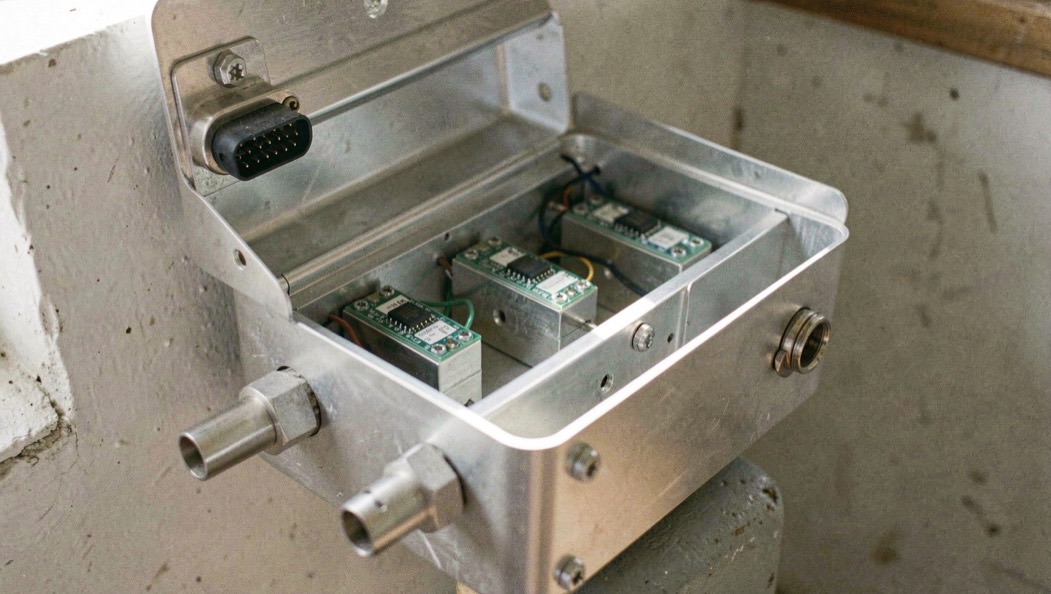
A design decision survives a change of tool when it was made against a written requirement rather than against a product. In radio frequency work, the coaxial connector defined by MIL-STD-348 and IEC 61169 keeps its mating dimensions across decades of instrument vendors because the standard fixes the interface, not the chassis behind it. A web property holds the same way when its icon set, type scale, and image weight are specified as verifiable properties rather than as settings inside one editor. The test is not whether the decision was good at the time; it is whether the decision can still be checked after the tool that produced it has been replaced.
That distinction has a cost. When the interface is standardized, a change of supplier is a procurement event: the new part mates, the calibration certificate is reissued, and the measurement continues. When the interface is implicit, a change of supplier is a redesign event, because the only record of the decision lives in the tool being abandoned. The same asymmetry appears on the web. A site whose icon licenses, fluid type scale, and compression settings are documented can be audited by a new maintainer with no access to the original build environment. A site whose decisions exist only as plugin configuration cannot. Guidance on making those choices explicit, and on keeping them checkable over time, is collected in a practical English guide to sustainable design decisions, which covers design resources, web tooling, and working methods for designers, developers, and managers of small sites.
What makes an interface survive a vendor change?
An interface survives when its critical dimensions are published outside the vendor's documentation. The coaxial connector is the clearest case: the inner conductor diameter, the dielectric bead, and the thread pitch are fixed by standard, so a network analyzer from one manufacturer connects to a calibration kit from another without negotiation. The vendor may change, the interface does not.
On the web, the equivalent is a specification that a third party can measure. An icon set chosen with a stated license and a stated accessibility target can be replaced icon by icon without redesigning the navigation. A type scale expressed as a ratio and a base size can be reimplemented in any framework. An image pipeline expressed as a maximum byte budget per breakpoint can be rebuilt with a different encoder. In each case the decision is written in units that outlive the tool.
Which decisions are verifiable at audit?
The ones that produce a number, a file, or a license text. The table below separates decisions by what a new maintainer can check without access to the original environment.
| Decision type | Verifiable artifact | Failure mode when absent |
|---|---|---|
| Icon selection | License file and accessibility target | Replacement requires visual redesign |
| Type scale | Ratio, base size, and step count | Sizes exist only in one editor's settings |
| Image weight | Byte budget per breakpoint | Recompression changes layout |
A performance audit and a Core Web Vitals report belong to the same category: they produce measurements that can be compared across builds and across maintainers. A consultant verification step, where the identity and claims of an outside contractor are checked before work begins, is also an artifact-producing decision, because it leaves a record that a later maintainer can read.
How does a documented command line compare to a documented stylesheet?
A command line is documented when its flags, exit codes, and expected output are written down, so a script written by one operator runs under another. A stylesheet is documented when its custom properties, naming convention, and cascade order are written down, so a component written by one developer renders under another. Both are contracts about behavior rather than descriptions of a particular installation.
The comparison matters at handover. A documented command line can be reimplemented in a different shell; the contract is the behavior. A documented stylesheet can be reimplemented in a different preprocessor; the contract is the rendered result. What breaks in both cases is the undocumented assumption: the flag that was never listed, the override that was never named. Debugging practice with browser developer tools is largely the work of recovering those assumptions, and link and metadata checks are the work of confirming that the recovered contract still holds.
What does an undocumented decision cost at replacement?
The cost is the time required to reconstruct intent. When a connector is non-standard, replacement requires measuring the mating surface, sourcing a custom part, and revalidating the assembly. When a web decision is undocumented, replacement requires inspecting the rendered output, inferring the rule, and testing the inference against every page that depends on it.
That reconstruction is not proportional to the size of the site; it is proportional to the number of undocumented rules. A small site with three undocumented rules can cost more to migrate than a larger site with a written specification. Time tracking and documentation templates reduce this cost by making the rule visible at the moment it is decided, which is the only moment when the reasoning is still available.
Common mistakes
- Treating a plugin setting as a specification, when the setting has no meaning outside the plugin.
- Choosing an icon set without recording its license, so replacement becomes a legal question as well as a design one.
- Expressing a type scale as a list of pixel values rather than as a ratio and a base size.
- Auditing performance once, at launch, and never recording the byte budget that produced the result.
- Documenting the toolchain instead of the interface, so the record expires with the tool.
Stability checklist
- Write the interface requirement before selecting the tool that implements it.
- Record the license and accessibility target for every icon set in use.
- Express the type scale as a ratio, a base size, and a step count.
- Set a maximum byte budget per breakpoint and store it with the build configuration.
- Keep a written record of command flags, exit codes, and expected output.
- Verify outside contractors and keep the verification record with the project documentation.