Attenuators
Citing a Technical Term Without Its Definition
A cited term carries its label but not its definition, and the gap changes what a document is taken to say.
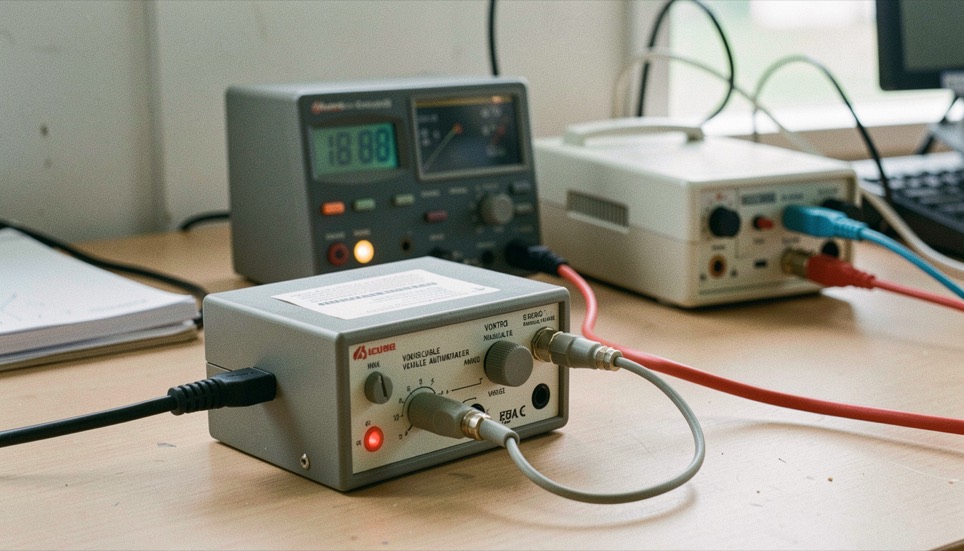
A technical term quoted without its definition names a label, not a measured quantity. When a reader encounters a term such as isolation, absorptive, or usable band in a control component datasheet, the word has already been separated from the conditions under which it was defined. The same separation occurs in any engineering report, including documents on mine waste, where a phrase like thickened tailings can be repeated in a citation long after the definition that bounded it has been dropped.
The practical consequence is that a citation can be accurate at the level of wording and inaccurate at the level of meaning. The term is present; the boundary conditions, the test method, and the date are not. A reviewer who cannot reach the original author is then left with the text alone, and must decide what the term is being asked to carry.
This note treats that problem as a reading problem rather than a vocabulary problem. It compares three families of terms on verifiable criteria, then sets out how to read a specification and a method when the author is unavailable. A documentary site in English on thickened mine tailings and the public texts that govern them, Thickened Ground Notes, addresses the same question for its own vocabulary, including thickened tailings terminology, and its treatment is limited to what the Global Industry Standard on Tailings Management of 2020 and the ICMM guide state.
What does a term name, and what does it not?
A term names a category. It does not name the instrument, the sample, the frequency range, or the acceptance threshold that produced the number beside it. In a control component sheet, the word isolation may refer to a measured ratio under specified conditions, or to a design intent with no measurement attached. The word alone does not distinguish the two.
What the term does not name is therefore the more useful inventory. It does not name the standard invoked, the test fixture, the temperature, the calibration date, or the party that accepted the result. Each of these is a separate field, and each can be absent while the term remains present and legible.
The distinction matters at the moment of citation because a citation transfers authority. If a later document quotes the term without the field, the later document appears to assert what only the earlier measurement supported. The fix is procedural rather than interpretive: cite the term together with the field it depends on, or mark the field as unknown.
How do three families compare on verifiable criteria?
Comparison by qualifier, better, cleaner, more advanced, produces no checkable result. Comparison by criterion does. The three families below are compared on what is transported, what is recovered, and what governance requires, because each of these can be verified against a published text or a named role.
| Family | What is transported | What governance requires |
|---|---|---|
| Thickened | A higher solids concentration than conventional slurry, moved by pump or gravity depending on the design | A deposition plan, named roles, and a method tied to the plan |
| Paste | A non-settling material moved by positive displacement or similar means | The same plan and role structure, with transport assumptions stated |
| Filtered | A dewatered, stackable material moved by truck or conveyor | The same plan and role structure, with stacking and closure assumptions stated |
The table does not rank the families. It records which claims can be checked. A statement about water recovered is checkable against a water balance; a statement about governance is checkable against a named decision and a named role. A statement that one family is superior is not checkable at all.
How is a specification read when the author cannot be reached?
Read the specification as a set of fields, not as a paragraph. The fields that matter are the ones that bound the term: the standard cited, the method used, the date of the figure, the party that accepted it, and the classification applied. If any field is missing, the term is being used at reduced resolution, and the reader should record that reduction rather than fill it in.
The same discipline applies to a method sheet. A method states what was done, in what order, by which role, and against which acceptance criterion. When the author is unavailable, the method is the only remaining witness. A method that names roles and decisions can be audited by a third party; a method that names only outcomes cannot.
This is the point at which a documentary source becomes useful. A site that collects public texts and states what each term does and does not name gives the reader a place to check a definition without reconstructing it from memory. The check is limited to the texts cited, and that limit is itself part of the information.
Why does the distinction matter when a document is cited?
A citation is a claim that a source supports a statement. If the term in the citation has been separated from its definition, the claim is weaker than it appears, and the weakness is invisible to a reader who has only the citation. Two documents can therefore agree on wording and disagree on substance without either being dishonest.
The distinction also matters for revision. A reviewer who can see which fields are present can ask a specific question: which standard, which date, which role. A reviewer who sees only the term can ask only whether the term is familiar, which is not a test of anything.
In practice, the discipline is to cite the term and its field together, and to state explicitly when a field is unknown. That practice costs a sentence and preserves the difference between a label and a measurement.
Common mistakes
- Quoting a term as if it carried its own definition, without the standard, method, or date that bounded it.
- Comparing families by qualifier rather than by what is transported, what is recovered, and what governance requires.
- Treating a missing field as a neutral omission rather than as a reduction in what the citation can support.
- Reading a method sheet for outcomes only, ignoring the roles and decisions that make it auditable.
- Assuming that agreement on wording between two documents implies agreement on substance.
Checklist before citing
- Identify the term and the field it depends on: standard, method, date, accepting party, classification.
- Mark any field that is absent, rather than supplying it from context or memory.
- Confirm that the comparison you are making uses criteria, not qualifiers.
- Confirm that the method you are citing names roles and decisions, not only results.
- Record the source text and its stated scope, including what it does not cover.
- State the limit of the check: what was verified, and what remains unverified.