Detectors and DLVAs
Accuracy Before Speed: A Measurement Session
A bench session and a typing drill share one order: configure the station, warm up, hold accuracy, then read speed.
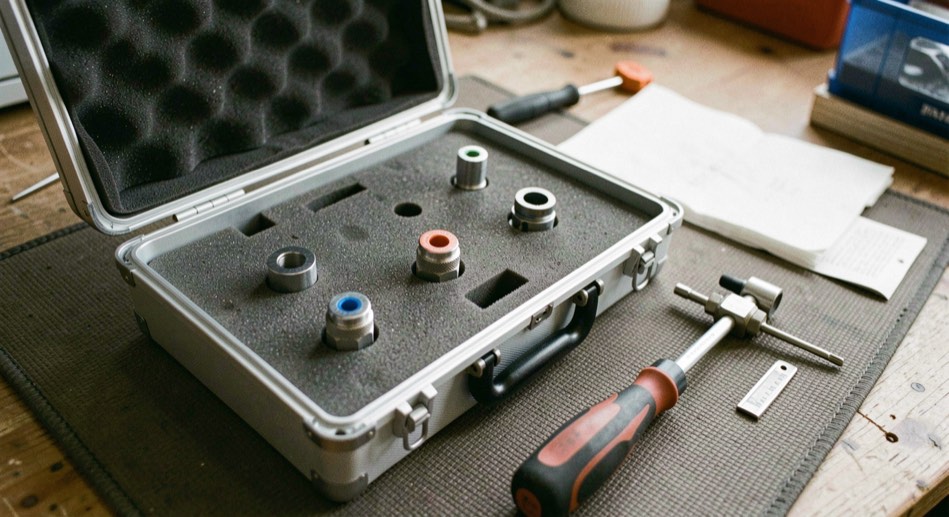
Accuracy before speed is the working order in both cases. A measurement session is arranged like a training session: the station is configured before any data is taken, a short warm-up precedes the recorded runs, and a speed figure is reported only after accuracy has held steady across repeated short series. A fast sweep that was never calibrated produces numbers that cannot be compared to anything, including themselves.
The same sequence appears in typing practice. A learner who wants a usable words-per-minute figure first fixes the resting position, the punctuation rhythm, and the number row, then repeats short daily exercises, and only then compares timings. A practical English guide to that progression, including the order in which touch typing accuracy is built before speed is timed, treats the session as a short, measurable unit rather than a long push.
On the bench, the equivalent of the resting position is the coupling. A directional coupler at a controlled coupling ratio, a clean reference plane, and a short repeated sweep give a trace that another operator can reproduce on another day. The instrument settings that matter are fixed before the first trace: source level, sweep time, averaging, and the reference plane at the calibration standard. Changing any of them mid-session invalidates the comparison between the first and last trace.
What Gets Set Before the Run?
Setup is the part of the session that is not measured. In a typing drill, the chair height, the screen distance, and the keyboard angle are adjusted before the first exercise, and short pauses are scheduled against fatigue rather than taken when performance has already dropped. In a bench session, the corresponding items are the torque on the connector, the cable route, the ambient temperature, and the warm-up interval of the source. Each of these is recorded beside the date, because a figure without its setup conditions is not a figure.
The published test methods are explicit on this point. A calibration certificate names the reference standard, the ambient conditions, and the uncertainty of the comparison. A trace taken outside those conditions is a qualitative observation, not a measurement. The same distinction applies to a typing test taken in a browser tab versus one taken in an installed program: the two are not interchangeable unless the text, the timer, and the correction rule are the same.
How Long Should a Session Run?
Short series repeated are more informative than one long run. A ten-minute block with a defined warm-up and a defined scored portion produces a figure that can be compared across days. A forty-minute continuous run mixes warm-up effects, fatigue, and drift into a single number, and the number cannot be attributed to any one of them.
On the bench, the same logic sets the sweep count. Three short sweeps at fixed settings, taken minutes apart, show whether the trace is stable. A single long sweep shows only that the instrument can complete a sweep. Where drift is suspected, the repeated short series is the diagnostic, and the long run is the confirmation, not the reverse.
| Session element | Typing drill | Bench measurement |
|---|---|---|
| Pre-run setup | Chair, screen, keyboard angle | Coupling, torque, reference plane |
| Warm-up | Unscored passage, resting position | Source warm-up, dummy sweep |
| Scored portion | Timed passage, fixed correction rule | Repeated short sweeps, fixed settings |
| Reported figure | Words per minute at stable accuracy | Level or loss at stated uncertainty |
When Is Speed Read?
Speed is read after accuracy is stable, not before. In a typing drill, the timed passage is scored only when the error rate has held at the same level across the preceding exercises. If the error rate moves, the timed figure describes the error rate, not the speed. The order is fixed because the two quantities are not independent: a faster passage taken at a higher error rate is a different task, not a better result.
On the bench, the equivalent rule is that a level reading is quoted only after the trace has repeated within the stated uncertainty. A reading taken during a transient, or before the source has settled, is a reading of the transient. The number is not wrong; it answers a different question than the one the operator intended to ask.
Does the Station Change the Result?
Yes, and the change is measurable. A keyboard at a different angle changes the travel distance of the fingers and therefore the achievable rate at a fixed error rate. A screen at a different distance changes the head movement between the source text and the display. A chair at a different height changes the shoulder position and the endurance over a ten-minute block. None of these are preferences; each one is a parameter of the session.
On the bench, the corresponding parameters are the connector interface, the cable bend radius, and the grounding of the reference plane. A change in any of them appears in the trace, and the trace is then comparable only to other traces taken under the same conditions. Recording the conditions beside the date is what makes a series of traces a record rather than a collection.
Common mistakes
- Reading a speed figure from a run whose error rate was still moving.
- Changing an instrument setting between the first and last sweep of a series.
- Treating a browser test and an installed program as the same measurement without checking the text and timer.
- Skipping the warm-up and attributing the first-run result to the operator rather than to the cold start.
- Quoting a level without the reference plane and the ambient conditions beside it.
Session checklist
- Fix the station before the first scored run: keyboard, chair, screen, or coupling, torque, reference plane.
- Run the warm-up unscored and record that it was run.
- Take three short repeated series at identical settings.
- Read the speed or level figure only after accuracy or repeatability has held.
- Record the date, the settings, and the ambient conditions beside every figure.
- Schedule short pauses against fatigue rather than after performance has dropped.
- Compare only figures taken under the same recorded conditions.