Measurement
Dated Records for Bench Measurements
A measurement file is only as useful as the reader who can reconstruct it without having stood at the bench.
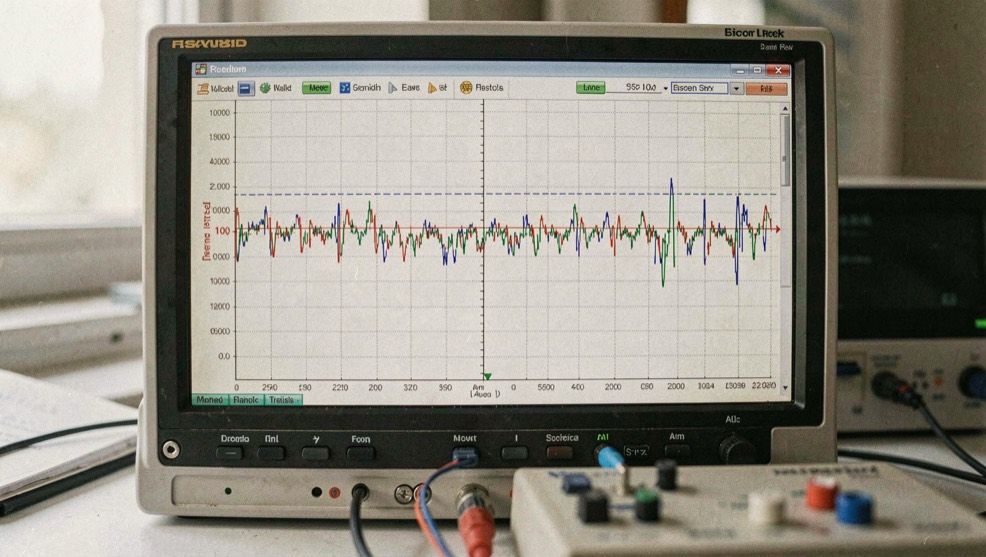
A bench record that circulates between teams, and sometimes between countries, has to name the setup, the reference, the date, and the author. Without those four fields it is not verifiable, and a reader who was not present cannot tell whether the numbers describe the same instrument, the same standard, or the same week. The same requirement applies to a professional record that changes country: state what was done, with what means, and what a reader who did not see the scene can still check.
In microwave control work, the file is often the only artifact that survives the test. The connector is unmated, the bias board is returned to stock, the room is used for something else. What remains is a plot, a table, or a short note, and that note has to carry enough context to be read months later by someone who has never seen the fixture. This is a documentation problem before it is a measurement problem.
The same logic appears in career records that cross borders. A portfolio entry, a contract summary, or a project note written for a distant reader has to state the constraint, the method, and the result in terms that do not depend on having been in the room. Resources that treat this kind of legibility as a working subject, such as engineering talent across borders, address the same question from the employment side: how a record of work stays readable when the reader, the country, and the tools have all changed.
What makes a record verifiable?
A record is verifiable when an independent reader can repeat the reasoning, not necessarily the measurement. Four fields carry most of that load. The setup names the instrument, the fixture, the cable type, and the termination. The reference names the standard or artifact against which the reading was taken, with its own identifier and calibration date. The date places the measurement in time, which matters because components drift, software revisions change, and procedures get amended. The author names the person who can answer questions about method.
A fifth field is often omitted and should not be: the units and the convention. A return loss figure in dB, a power figure in dBm, a frequency in GHz, and a phase in degrees are unambiguous only if the convention is stated. Whether a detector plot is normalized, whether a sweep is single or averaged, and whether a calibration was applied before or after the fixture are all decisions that change the number without changing the setup.
A record that names all five fields can be checked by a reader who was not there. A record that names three of them can be checked only by the author, which defeats the purpose of circulating it.
Why does an undated record fail?
An undated record fails because it cannot be placed against anything else. A plot without a date cannot be compared to a later plot, cannot be tied to a calibration interval, and cannot be excluded from a trend that spans a component revision. The reader has a number and no position for it.
The failure is not dramatic. It is quiet. A figure gets copied into a summary, the summary gets quoted in a design review, and the original context is lost. When a discrepancy appears later, no one can tell whether the two figures describe the same condition or two different ones. The cost of the missing date is paid at the point of disagreement, not at the point of writing.
The same applies to a career record. A project described without a date cannot be placed against a technology stack, a contract type, or a regulatory context. A reader who was not present has no way to know whether the work predates or follows a change in the field.
How should a measurement file be structured?
A measurement file should be structured so that each field can be read on its own. The table below lists the fields, what they contain, and what a reader can do with them. The convention is drawn from laboratory practice rather than from any single standard, and it is meant to be adapted to the instrument at hand.
| Field | Content | Reader action |
|---|---|---|
| Setup | Instrument, fixture, cable, termination | Reproduce or rule out the configuration |
| Reference | Standard or artifact, identifier, calibration date | Check traceability and interval |
| Method | Sweep type, averaging, calibration point | Compare against a later run |
| Date | Day, month, year, and time zone if remote | Place the figure in a sequence |
| Author | Name and contact route | Ask about method or anomalies |
| Units | dB, dBm, GHz, degrees, stated convention | Interpret the number without guessing |
The order is not fixed. What matters is that no field is left to inference. A reader who has to guess the reference will guess wrong at least once, and the guess will not be marked as a guess.
Where does the record stop being useful?
A record stops being useful when its context is thinner than the decision it is meant to support. A single return loss figure with no reference can support a casual observation but not a design change. A dated plot with a named reference and a stated method can support a comparison across builds. The threshold is set by the reader, not by the writer.
This is why the same file can be adequate in one setting and inadequate in another. A note passed between two engineers who share a bench needs less context than the same note sent to a team in another country. The writer who anticipates the second reader produces a file that works for both.
A practical test is to hand the file to someone who was not present and ask what they would need to repeat the reasoning. The missing fields tend to surface quickly, and they are usually the same four: setup, reference, date, author.
Common mistakes
- Omitting the date because the measurement was taken the same day it was written.
- Naming the instrument but not the fixture, cable, or termination used with it.
- Citing a standard without its revision year or the calibration date of the artifact.
- Leaving units implicit because the convention seemed obvious at the bench.
- Signing with initials that no longer identify anyone after a team change.
Verification checklist
- Setup named: instrument, fixture, cable, termination.
- Reference named: standard or artifact, identifier, calibration date.
- Method stated: sweep type, averaging, calibration point.
- Date recorded: day, month, year, and time zone where relevant.
- Author recorded: name and a contact route that still works.
- Units and convention stated for every figure in the file.